
International Scholars and Academics Honor Prof. Nirmala Mani Adhikary at Two-Day Golden Jubilee Celebration
“Professor Nirmala Mani Adhikary has made remarkable contributions in enriching communication scholarship through eastern philosophical perspectives and indigenous knowledge systems,”
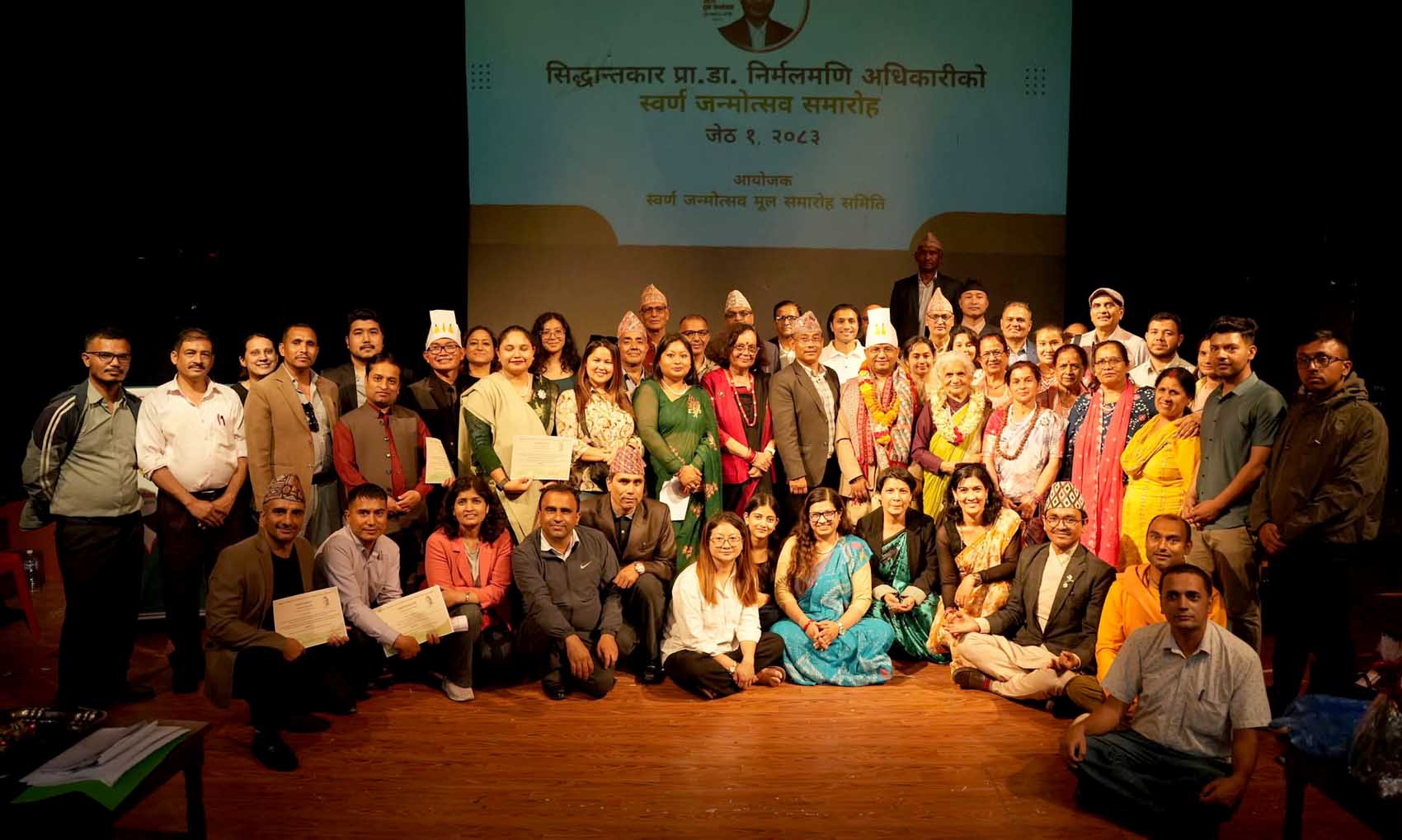
Kathmandu (Nepal): The Golden Jubilee Celebration of communication theorist and scholar Professor Dr. Nirmala Mani Adhikary concluded this week in Kathmandu after two days of academic discussions, cultural performances and international tributes honoring a career that has shaped contemporary discourse on communication, indigenous knowledge systems and civilizational thought in Nepal and beyond.
The event, attended by distinguished academicians, media scholars, researchers, doctoral candidates, cultural figures and well-wishers from several countries, served both as a celebration of Professor Adhikary’s 50th birthday and as a reflection on the intellectual legacy he has built through decades of scholarship, teaching and philosophical inquiry.
The celebration opened with an international webinar session featuring noted Indian media academician K.G. Suresh as chief guest. Addressing participants from different countries, Mr. Suresh said Professor Adhikary had expanded the horizons of communication studies by drawing from eastern philosophical traditions and indigenous epistemologies.
“Professor Nirmala Mani Adhikary has made remarkable contributions in enriching communication scholarship through eastern philosophical perspectives and indigenous knowledge systems,” Mr. Suresh said. “His academic dedication continues to inspire scholars across borders.”
The keynote speaker, Nicolas Boin Principato, reflected on the growing international relevance of Professor Adhikary’s writings and theoretical contributions. He described Adhikary’s work as an intellectual bridge connecting cultures, traditions and academic disciplines.
“Professor Adhikary’s intellectual vision and interdisciplinary scholarship have created meaningful dialogues among diverse academic and civilizational traditions,” Mr. Principato said. “His works will remain valuable references for future generations of communication scholars.”
The academic sessions formed the intellectual center of the two-day gathering. On the first day alone, 23 research papers were presented on themes ranging from communication theory and media studies to philosophy, culture and indigenous knowledge systems. Six additional papers and formal presentations were delivered during the second day’s sessions.
Scholars from universities and research institutions engaged in extended discussions on the contemporary relevance of indigenous perspectives in communication studies and public discourse. Participants noted that the event had become more than a commemorative gathering, evolving instead into a broader intellectual forum on the future direction of communication scholarship in South Asia.
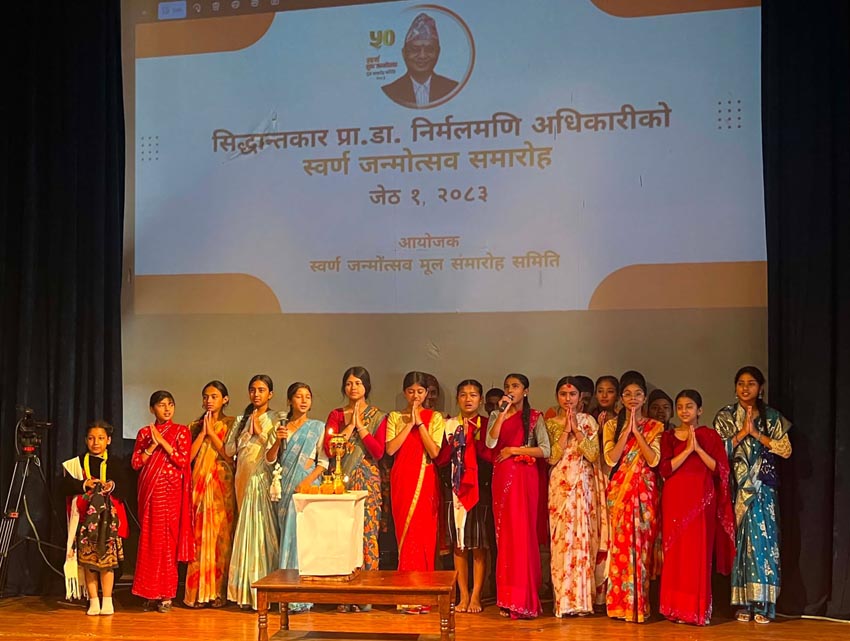
The celebration also featured a series of cultural presentations representing Nepal’s diverse civilizational traditions. Traditional dances, ceremonial performances and literary presentations lent the event a reflective and festive atmosphere.
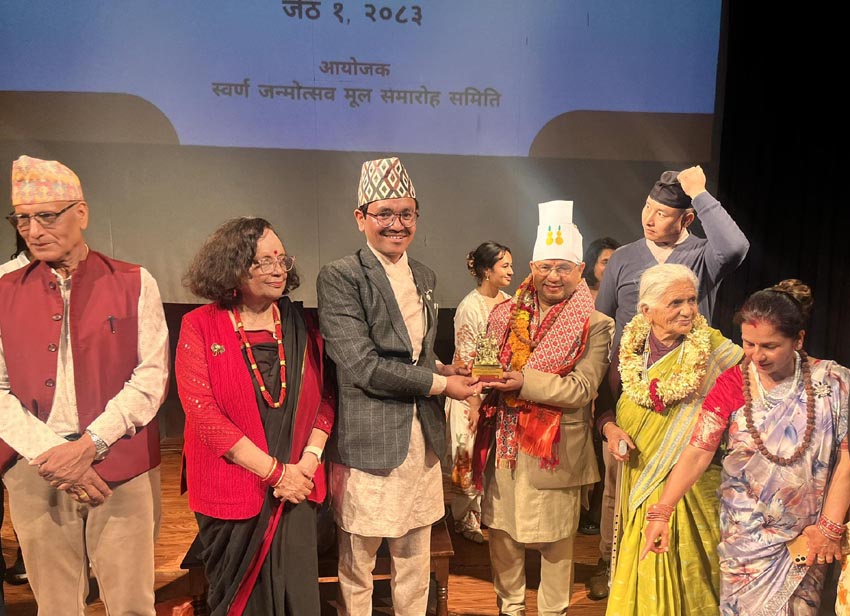
The formal birthday ceremony began with the lighting of a ceremonial lamp by the chief guest, Professor Dr. Beena Poudyal. This was followed by a Vedic Swastivachan recitation led by Ananda Prasad Ghimire and his group. Buddhist Mangala chants were delivered by Tika Sherpa, chairperson of the Buddha Bachan Translation Committee and a scholar of Buddhist philosophy, while Kirat ceremonial blessings were presented by Madan Rai of the Kirat Thulung Rai community.
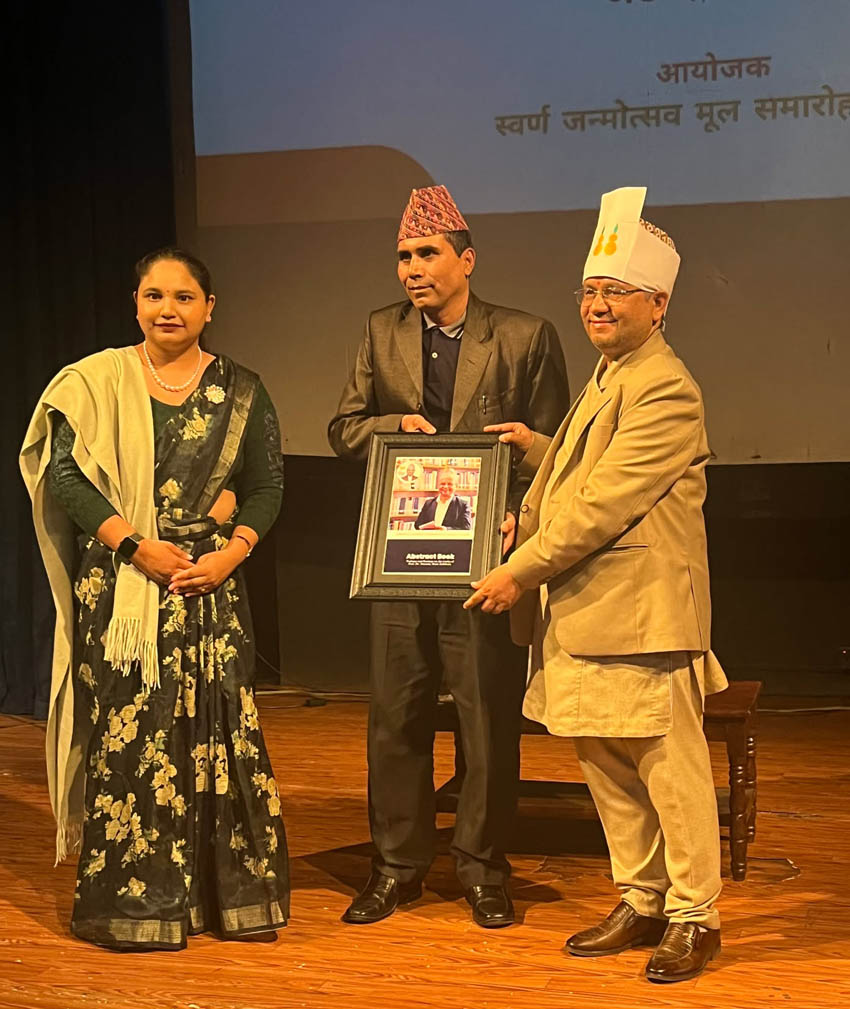
The program also included the release of a video presentation of a poetry work by Usha Adhikari, head of the Nepali Department at Tri-Chandra Campus. Prof. Dr. Madhav Prasad Pandey, Coordinator of world Sanskrit Day, unveiled a Baghchal board game inspired by traditional Nepali cultural heritage. A documentary feature produced by Deepa Basnet was also formally released during the ceremony.
Speaking at the second day’s special session, Chief Guest Prof. Dr. Beena Poudyal extended her greetings and best wishes to Prof. Dr. Adhikary, describing his life as a reflection of dedication, humility and academic excellence.
“Professor Adhikary’s life stands as an inspiring example of commitment, simplicity and intellectual excellence,” she said. “As a teacher, researcher and mentor, he has had a profound and positive impact on countless students and scholars.”
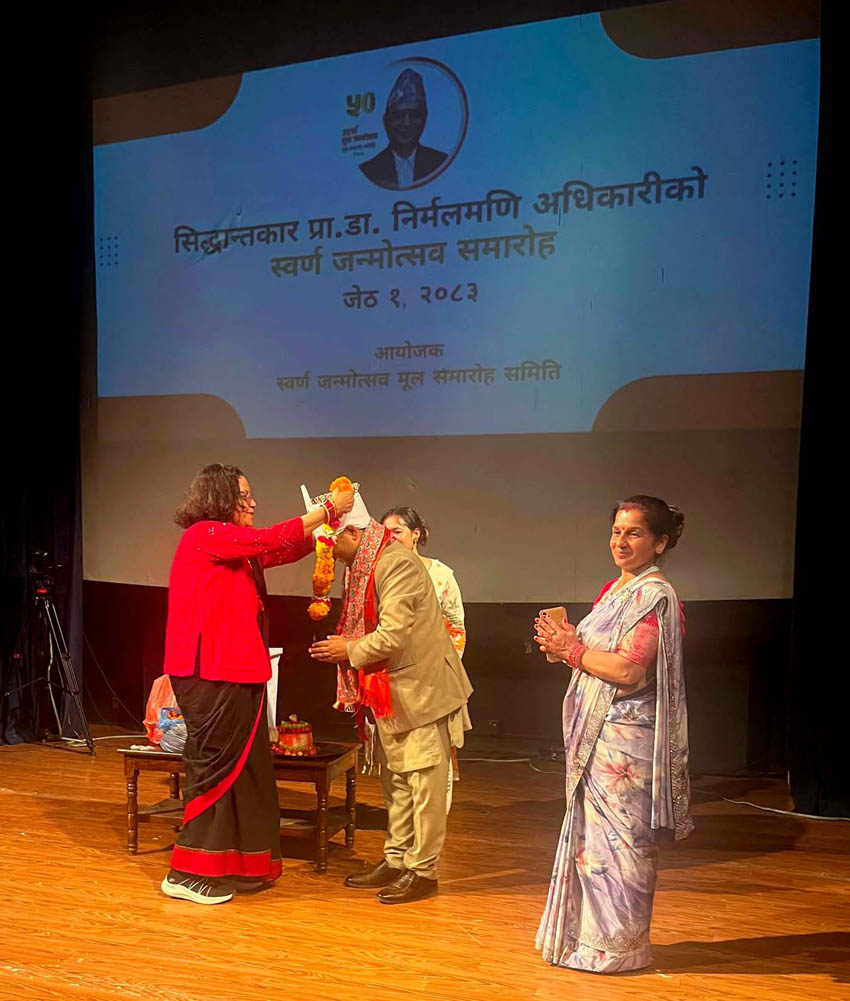
Among the speakers, Buddha Chhiring Lama emphasized the contemporary significance of Professor Adhikary’s philosophical frameworks in understanding Nepal’s evolving political and geopolitical realities.
“The intellectual paradigms advanced by Professor Nirmala Mani Adhikary offer important perspectives for Nepal’s political discourse and policy orientation,” Mr. Lama said. “Given Nepal’s sensitive geopolitical position and the changing global order, it is increasingly important for political leadership and academic institutions to seriously engage with indigenous philosophies and communication paradigms that promote national coherence, cultural diplomacy and strategic balance.”
Arun Poudyal (BD), chair of the program, thanked the speakers, organizers and participants for contributing to what he described as a meaningful and memorable gathering.
“This celebration is not only a tribute to Professor Adhikary’s achievements,” he said, “but also a collective recognition of his long-standing contribution to academia and society.”
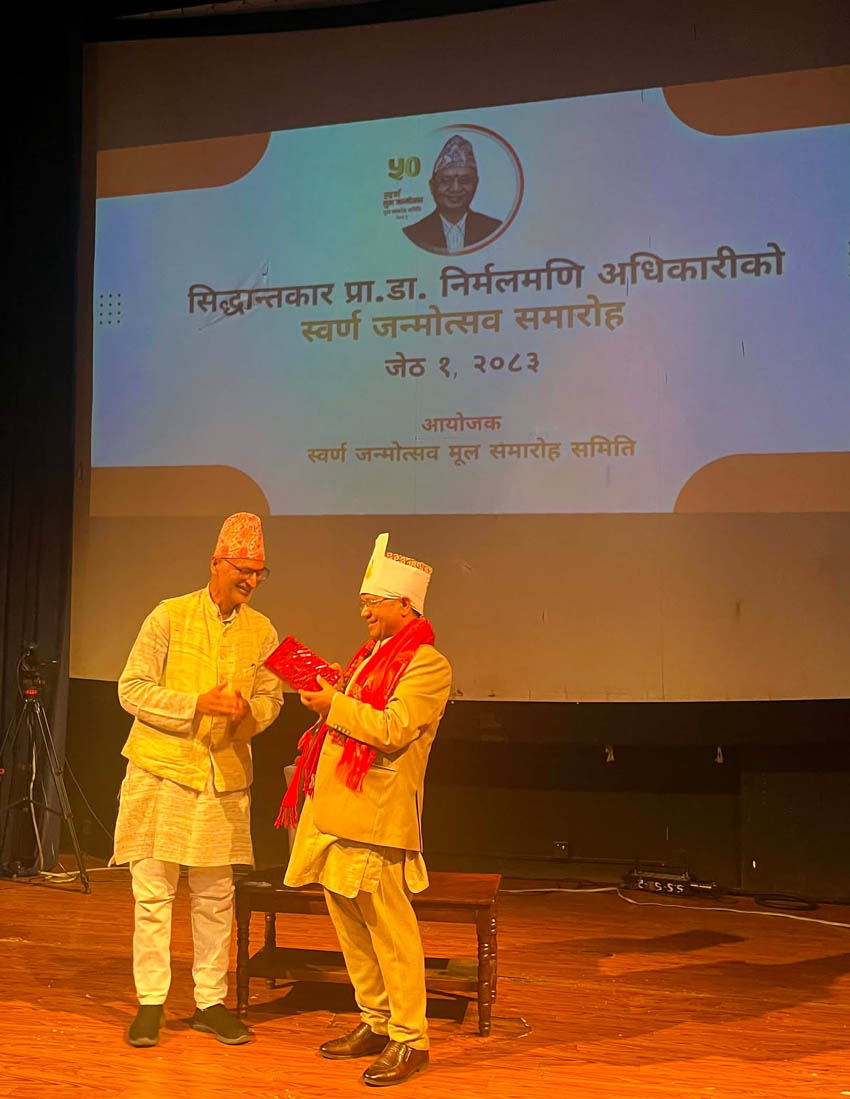
Professor Adhikary is widely recognized in Nepal and international academic circles for his contributions to communication theory, indigenous epistemology and civilizational studies. Among his notable theoretical frameworks are the Sadharanikaran Model of Communication, the concept of Sahridayata, the philosophy of Stato-dynamic Progressivism, and the State-Nation Theory, all of which are regarded as important contributions to contemporary indigenous thought in Nepal and beyond.
His work has consistently sought to connect communication studies with eastern philosophy, culture and native knowledge traditions, an approach many scholars view as a significant intellectual intervention in a field long dominated by western theoretical paradigms.
Over the course of his career, Professor Adhikary has authored more than 60 books and published over 100 research articles in national and international journals. He is also recognized as the first Nepali professor to complete both a Ph.D. and postdoctoral research in Journalism and Mass Communication in Nepal.
-

From the Himalayas, Nepal’s PM Delivers a Warning on Climate and a Challenge to the World
2026-09-25 -

Doctors Suggest Not to Use Toilet Papers
2026-08-18 -

Eight best home remedies for gastritis
2026-08-18 -

Advantages and Disadvantages of Inter-caste Marriage
2026-08-18 -

Top Seven Safe, Effective Natural Antibiotics
2026-08-18 -

Meditation: Techniques, Benefits
2026-08-18 -
4 Ingredients Available At Your Home To Flush Kidney Stones Naturally
2026-08-18 -

1.1 billion people live in slums. Can they be housed in dignity?
2026-05-18 -
International Scholars and Academics Honor Prof. Nirmala Mani Adhikary at Two-Day Golden Jubilee Celebration
2026-05-16 -
From Doubt to Delivery: Sudan Gurung Redefines Power at Nepal’s Home Ministry
2026-04-01