
From the Himalayas, Nepal’s PM Delivers a Warning on Climate and a Challenge to the World
“We are not here to blame a country or a continent,” he said. “We are not here to turn climate change into another geopolitical battlefield.”
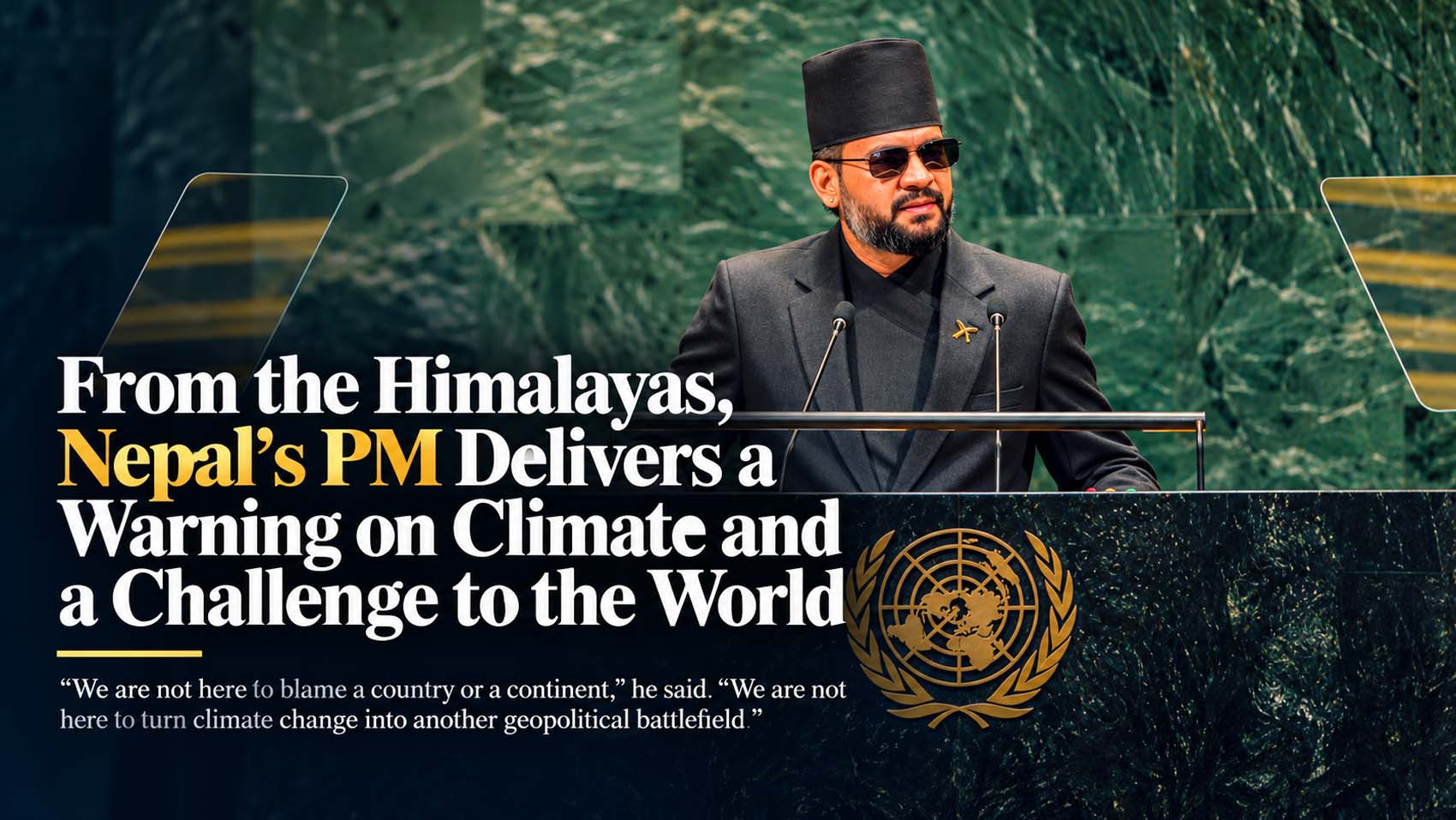
Prime Minister Balendra Shah of Nepal arrived at the United Nations General Assembly carrying an unusual distinction: at 36, he is the world’s youngest serving prime minister.
NEW YORK: Prime Minister Balendra Shah of Nepal arrived at the United Nations General Assembly carrying an unusual distinction: at 36, he is the world’s youngest serving prime minister.
But when he took the podium in New York, he made clear that age was not the story he wanted the world to remember.
Instead, he spoke of death.
He spoke of families waiting for relatives who may never return, of communities searching through mud, rock and floodwater for bodies that may never be recovered, and of roads, bridges, schools, homes and livelihoods erased within minutes.
Then he widened the frame.
The catastrophe that struck Nepal’s Himalayan region, Mr. Shah argued, was not simply a national tragedy. It was a warning from one of the planet’s most environmentally fragile regions and a test of whether the international community is prepared to turn decades of climate diplomacy into action.
“This was not merely a local tragedy,” he told the General Assembly. “It was also a warning to the world.”
It was an unusually stark opening for a leader making one of his most consequential appearances on the global stage.
And it established the central argument of his speech: For countries such as Nepal, climate change is no longer primarily an environmental question. It is a question of development, debt, justice and survival.
A Disaster Recast as a Global Warning
Four weeks before Mr. Shah’s speech, catastrophic flooding tore through communities along the Bhotekoshi-Trishuli corridor, an event he said had been described by many as a “Himalayan tsunami.”
According to figures presented by the prime minister, at least 1,400 people had been confirmed dead and more than 6,000 remained missing. Nepal’s preliminary damage assessment, he said, suggested that physical recovery alone could require resources equivalent to about 10 percent of the country’s gross domestic product.
For a wealthy country, rebuilding after disaster can be an enormous fiscal challenge.
For a lower-income country repeatedly exposed to earthquakes, floods, landslides and glacial hazards, the consequences can be more fundamental: infrastructure accumulated over decades can disappear in a single season, forcing governments to borrow simply to restore what already existed.
That distinction was at the heart of Mr. Shah’s appeal.
“For Nepal, climate disaster is not only a humanitarian event,” he said. “It is a development crisis.”
The floods, he argued, destroyed not only homes but roads, bridges, schools, agricultural land and sources of income. The infrastructure on which future economic growth depends.
And that creates what increasingly vulnerable countries describe as a cruel cycle: development, destruction, borrowing and reconstruction, followed by another disaster.
Mr. Shah’s argument was that such a cycle cannot reasonably be described as climate justice.
Nepal Emits Little. It Pays Heavily.
Nepal contributes less than one-tenth of 1 percent of global greenhouse gas emissions, Mr. Shah said.
Yet its geography places it on one of climate change’s most consequential front lines.
Its glaciers are retreating. Permafrost is thawing. Mountain slopes are becoming unstable. Glacial lakes present growing risks. River systems that sustain communities far beyond Nepal’s borders are becoming increasingly unpredictable.
“This crisis was not created by us,” Mr. Shah said. “But we are paying a heavy price for it.”
That imbalance between responsibility for global warming and exposure to its consequences have long been central to climate negotiations.
Mr. Shah gave it a distinctly Himalayan formulation.
A warming atmosphere destabilizes mountain systems. Melting ice and shifting rainfall patterns do not remain inside national boundaries. Floodwaters move downstream, connecting Nepal environmentally to China to its north and India to its south.
His description was memorable precisely because it stripped climate diplomacy of its technical vocabulary.
“Glaciers and floods do not travel with visas stamped in their passports.”
Behind the line was a serious geopolitical proposition: climate security in the Himalayas cannot be addressed by Nepal acting alone.
A Himalayan Alliance Across Three Countries
Mr. Shah used the General Assembly to propose a Himalayan Climate Resilience Mechanism, led initially by Nepal, India and China.
Under his proposal, the three countries would share satellite data and scientific expertise, jointly monitor potentially dangerous glacial lakes, strengthen early-warning systems and coordinate cross-border responses when disasters occur.
The proposal is significant because the Himalayan environment is shared by countries whose political relationships are often more complicated than their ecological interdependence.
Rivers cross frontiers regardless of diplomatic tensions. Glacial collapse in one country can create consequences downstream in another. Weather systems do not recognize territorial disputes.
Mr. Shah suggested that this shared vulnerability could become a foundation for cooperation.
“Let us make the Himalayas a laboratory for international cooperation rather than fragmented information,” he said.
Whether India and China embrace the idea, and what institutional form such a mechanism could take, remain open questions.
But the proposal marked an effort by Nepal to move beyond the familiar role of climate victim and position itself as a convening state, a small country attempting to shape regional policy around a problem larger than itself.
Six Words and a Different Definition of Climate Justice
Perhaps the most carefully constructed passage of Mr. Shah’s speech came when he asked the General Assembly to remember six words:
Relief. Recovery. Reconstruction. Responsibility. Compensation. Resilience.
The first three describe what countries need after catastrophe.
The final three address why catastrophes repeatedly devastate the countries least equipped to absorb them.
That distinction matters.
International disaster assistance has traditionally been strongest after the event: emergency food, medical assistance, shelter, reconstruction loans and humanitarian appeals.
Mr. Shah argued that a climate-altered world requires a different architecture; one that does not leave poorer countries repeatedly borrowing money to rebuild infrastructure destroyed by a crisis to which they contributed little.
“When a climate disaster destroys the infrastructure of a poor country,” he said, “the answer cannot simply be another large loan or fragmented grants.”
Nepal, he said, needs substantially more grant-based assistance.
He also criticized the complexity of accessing international climate finance, arguing that mechanisms intended to help vulnerable countries can become so bureaucratic that assistance arrives too slowly.
Then he offered one of the speech’s simplest analogies.
“When a house is on fire, we do not ask the family to fill out 50 forms. We act.”
“That,” he added, “must also be what climate justice means.”
The language reflected a larger frustration among developing countries: that international climate institutions have become increasingly sophisticated in their terminology while remaining painfully slow in delivering money to communities already living with the consequences.
From Climate Finance to the Architecture of Power
Mr. Shah then moved beyond climate policy.
His larger question was what kind of international order the world intends to preserve.
The United Nations, he reminded delegates, emerged from the devastation of World War II with a promise: sovereignty would matter, international law would matter, human dignity would matter and smaller countries would not simply be required to accept whatever powerful states decided for them.
That promise, he suggested, is under strain.
Too often, he said, military and economic power still determine whose voice is heard.
For Nepal, the consequences appear not only in diplomacy but in daily economic life.
Mr. Shah described a farmer unable to obtain fertilizer when planting season arrived. A government unable to secure bitumen for road construction. A family struggling to obtain cooking fuel.
Then he contrasted those shortages with the efficiency of the global arms trade.
“Intercontinental missiles arrive on time,” he said. “Rifles and ammunition cross borders, overcoming every obstacle. But a farmer in Nepal cannot buy fertilizer or fuel at market price when it is needed.”
The comparison was deliberately provocative.
“We have created a world in which it is easier to supply what is needed for war than what is needed for food.”
It was one of the speech’s sharpest critiques.
Mr. Shah was no longer speaking only about climate change. He was questioning the allocation of technological capacity, finance and political attention in the international system itself.
If the world can move weapons across continents in a matter of days, he argued, then chronic failures to deliver agricultural inputs, climate finance or disaster assistance cannot always be explained by a lack of capacity.
They are also questions of priority.
The Youngest Prime Minister : Who Did Not Want Age to Be the Headline
Mr. Shah eventually acknowledged the fact that had already attracted international attention.
“I have been told that I am the youngest head of government addressing this Assembly this year,” he said.
Then he immediately dismissed its importance.
“But I have not come here to make that the main story.”
The line was revealing.
Youth has been central to Mr. Shah’s political identity, but in New York he attempted to transform it from biography into argument.
His government, he said, emerged from a new democratic mandate shaped partly by a generation demanding honesty and accountability in politics.
Nepal’s young people, he said, want dignified employment, social protection and the possibility of building a life in their own country.
He presented that dissatisfaction not as an isolated Nepali phenomenon, but as part of a wider generational unease with conflict, inequality and narrowing opportunity.
“Our youth have demanded a politics of honesty and accountability,” he said.
For a country in which migration has become one of the defining facts of economic and social life, the promise of enabling young Nepalis to build their futures at home carries enormous political weight.
It also connects directly to climate change.
A generation entering adulthood today will spend much of its life confronting decisions made before it possessed political power: greenhouse gases already accumulated in the atmosphere, infrastructure built without climate resilience, ecosystems already under pressure and debts incurred to recover from disasters.
That is why Mr. Shah broadened his definition of climate justice beyond money.
It is, he said, a question of distributive justice, who pays.
It is a question of procedural justice whose voices shape decisions.
And it is a question of intergenerational justice whether the interests of those who have not yet been born are given the same weight as the interests of those making decisions today.
That may have been the speech’s most explicitly youth-centered idea.
The Himalayas as a Measure of Global Failure
Nepal’s case carries significance well beyond its population or economic size.
The Hindu Kush Himalaya supports water systems on which vast populations across Asia depend. What happens to its glaciers, snowpack and river systems can affect agriculture, ecosystems, hydroelectric power and livelihoods far downstream.
Mr. Shah therefore sought to reposition the Himalayas in the global imagination.
They are not, he argued, a spectacular but distant landscape at the edge of world affairs.
They are part of a planetary life-support system.
That framing has important implications.
For years, small island states have used rising seas to make the consequences of climate change visible to the international community.
Nepal is attempting to make a parallel argument from the mountains: melting glaciers and destabilized slopes are another form of planetary alarm.
From the sea, climate change appears as inundation.
From the Himalayas, it appears as disappearing ice, unstable earth and rivers that can become destructive with little warning.
Different landscapes, same atmosphere.
The Gap Between a Powerful Speech and Policy
A General Assembly address, however forceful, does not itself produce climate finance.
Nor does it create a regional mechanism involving three countries with very different geopolitical interests.
Mr. Shah’s proposals will now encounter the far less theatrical world of diplomacy: negotiations over funding, technical standards, data sharing, institutional authority and national sovereignty.
His government will also face scrutiny at home.
Calls for global accountability carry greater weight when accompanied by effective domestic governance: stronger building standards, transparent reconstruction, credible disaster planning, environmental protection and climate-resilient infrastructure.
The same principle applies to his appeal for a politics of accountability.
For a young government that has presented itself as an expression of generational change, the test will not be the freshness of its rhetoric but whether it can translate that rhetoric into institutions that work.
That distinction is particularly important because Mr. Shah himself repeatedly returned to the difference between warning and action.
Nearly three years ago, he recalled, the United Nations secretary-general stood in the Everest region and warned of an approaching climate catastrophe.
Scientists repeated that warning.
Communities living in the mountains understood it.
Political systems, Mr. Shah argued, did not respond quickly enough.
“We heard it in Nepal,” he said. “Our communities heard it. Scientists around the world heard it.”
But the warning, he said, was not translated into action “at the speed required by people at risk.”
The disaster that followed became, in his telling, evidence of that failure.
A Young Leader’s Argument to an Older World Order
There was a striking contrast at the center of Mr. Shah’s appearance.
He is a young prime minister representing an ancient civilization; a leader of a small state addressing institutions largely designed by the major powers of the 20th century; and the head of government of a low-emitting nation demanding answers from an economic order built during the fossil-fuel age.
That contrast gave his speech much of its political resonance.
But he stopped short of assigning blame to individual countries.
“We are not here to blame a country or a continent,” he said. “We are not here to turn climate change into another geopolitical battlefield.”
Instead, he invoked a principle already embedded in international climate agreements: countries share responsibility for addressing climate change, but that responsibility differs according to their historical contribution and capacity to act.
Those with greater responsibility and greater capacity, he said, must do more.
It was an appeal for cooperation, but not an appeal stripped of accountability.
“Climate justice,” he said, “must not remain merely a beautiful phrase in United Nations documents.”
From the Roof of the World
Near the end of his speech, Mr. Shah returned to where he had begun: the mountains.
He urged governments to move from a culture of reacting after catastrophe toward one of preparing before it.
Invest in resilience, he said.
Strengthen insurance and innovative financing.
Build infrastructure capable of surviving extreme weather.
Reduce dependence on fossil fuels.
Create warning systems capable of saving lives.
And reform international arrangements that leave the most vulnerable with the least power to protect themselves.
Then came his final climate appeal:
“When the next warning comes from the roof of the world, let us be ready to listen and ready to act.”
The line distilled the larger purpose of the address.
Mr. Shah had taken a disaster in Nepal and presented it as evidence in a global argument: that climate change is exposing not only the fragility of mountains, rivers and communities, but also weaknesses in the institutions meant to protect them.
His age supplied an arresting backdrop.
But the deeper generational argument was about time.
Young people will inherit the climate, infrastructure, debt and international institutions that today’s leaders leave behind.
For them, another decade of eloquent warnings without proportionate action will not be an abstract diplomatic failure.
It will be the world in which they have to live.
Mr. Shah arrived in New York as the world’s youngest prime minister.
He used the podium to ask a much older international system whether it was prepared to act with the urgency of a generation that cannot afford to wait.
-

From the Himalayas, Nepal’s PM Delivers a Warning on Climate and a Challenge to the World
2026-09-25 -

Doctors Suggest Not to Use Toilet Papers
2026-08-18 -

Eight best home remedies for gastritis
2026-08-18 -

Advantages and Disadvantages of Inter-caste Marriage
2026-08-18 -

Top Seven Safe, Effective Natural Antibiotics
2026-08-18 -

Meditation: Techniques, Benefits
2026-08-18 -

4 Ingredients Available At Your Home To Flush Kidney Stones Naturally
2026-08-18 -
1.1 billion people live in slums. Can they be housed in dignity?
2026-05-18 -
International Scholars and Academics Honor Prof. Nirmala Mani Adhikary at Two-Day Golden Jubilee Celebration
2026-05-16 -

From Doubt to Delivery: Sudan Gurung Redefines Power at Nepal’s Home Ministry
2026-04-01